Our amazing little country
I love Costa Rica. Mainly I love the people here — their warmth and openness, their generosity. This is why I decided to make Costa Rica my home, in spite of not knowing two words in Spanish. That Costa Rica is spectacularly beautiful with astounding diversity also makes it a place everyone can appreciate, if you have the confidence and desire to move away from the hum-drum of cities and commercial tourism locations.
Costa Ricans have reason for genuine pride in being so different from other Latin countries, and being in so many ways better off than far wealthier North Americans. It comes in part from a long history of a very free press, good universal education, a decent public health care system, no military presence (domestic or foreign — no U.S. or other military bases here), a strong democratic government. It’s a small country (4.5 million people in an area about the size of West Virginia). There’s no real history of dictatorship, never had slavery. There’s no major link to drug trafficking or money laundering, and no "single industry" dominant company. Politics are pretty tame entertainment, and every four years the elections assure more colorful campaigning than the football championships. Families are closely woven together, yet easily make room for outsiders. The Costa Rican people are happy with their life style. In 2011 Costa Rica came out #1 in the world as the Happiest Country on Earth. Since 2009 Costa Rica has consistently made it into the Top 10 of this category.
These underlying values create a citizenry — Ticos, we call ourselves –both welcoming to foreigners and relatively safe for independent travel. With a few useful facts and tips you’ll find yourself exploring dirt roads and finding hidden waterfalls — discovering all by yourself why Ticos are so enchanted by our own country.
Two oceans, two climates
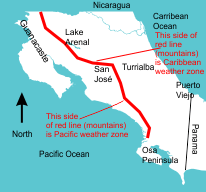
Only a low mountain range in the middle of a country 75 miles wide separates the Atlantic and Pacific Oceans. Because of these two oceans Costa Rica has surprisingly distinct weather — and climate — zones. The north and east zone is called the "Caribbean weather zone" (even though parts of that zone — the Osa Peninsula — are on the Pacific coast) and the "Pacific weather zone" (which includes most of population – San José and the Central Valley).
The Pacific Weather Zone
The Pacific zone has a very distinct dry season (mid December thru early April) and wet season (July thru November). During the dry season it’s clear skies and hot — daily temperatures on the beaches regularly reach 90°F (32°C), usually windy, and intense sunshine. March and April are the hottest months. San José is spared the highest temperatures because elevation (3800 ft or 1100 meters MSL) and spillover cooler air from the Caribbean zone nearby (the Continental Divide is between San José and Volare, 26 miles away).
Costa Rica’s north and central Pacific coasts are similar to southern California weather (minus fire storms). Pacific ocean storms produce really big rains, with roads closed and knocking out power and downing big trees. The mountain slopes facing the Pacific have stunted trees (the rainforest giants don’t survive well in dry season or wind) and are covered in short dry grasses ("chapparal"). North Pacific area (Guanacaste) is the driest and windiest part of Costa Rica, and the area crops (melons, mangoes, rice) rely heavily on irrigation. The irrigation water comes from the Caribbean Zone, from rivers diverted to Lake Arenal which then pass into Guanacaste.
The Pacific weather zone is home to popular beach destinations – Jaco, Tamarindo and the Nicoya and Guanacaste coastline down to Manuel Antonio.
Months not in wet or dry season are unpredictable… or actually, very predictable if you understand the effects of "El Niño" or "La Niña", weather phenomena involving ocean surface temperatures which affect the whole world’s rain patterns.
Caribbean Weather Zone
The Caribbean Weather Zone is overall more mild, both in temperatures (rarely reaches 88°F. / 31°C). Monthly variation in precipitation is remarkably little. As a result the Caribbean weather zone is always lush, always green, so is home to big rivers (like the Pacuare), rain forest and cloud forests (high altitude rain forest with a completely distinct set of plants and animals). The mountain slopes are covered in giant rainforest trees. Low and soft clouds form usually in mid morning and protect crops and people from intense sunshine (and produce dramatic sunsets). The Caribbean weather zone is the breadbasket of Costa Rica – vegetables, dairy, sugar, meats – as well as tourism centers like La Fortuna (Arenal Volcano), Tortuguero, Turrialba, Osa Peninsula. The Caribbean beaches are softer, but not as developed for tourism as on the Pacific.
Dairy and Coffee are high altitude products and grow in both the Caribbean and Pacific weather zones. Sugar cane, banana and pineapple are lowland Caribbean weather crops, while melons are irrigated crops from the Pacific weather zone.
TEMPORALS are storms that arrive and stay in an area for 3 to 5 days, usually affecting the entire country. There are no trade winds this close to the equator, so nothing pushes weather along. Temporals happen any time of the year, in all parts of Costa Rica, unpredictably, so there is no "temporal" season you can avoid.
"Here, Hurricanes Hardly Ever Happen" is true for Costa Rica. We are a small strip of land (at our narrowest point we are only 75 miles from Atlantic to Pacific coasts) and a central mountain range stops storms from either direction. More important, we are entirely SOUTH of Colombia and Venezuela, tucked protectively in a cozy corner of the Caribbean Sea, and hurricanes would have to work awfully hard to navigate this far south and against a lot of east-moving currents to get to us. That’s not saying we’ll stay this protected as the oceans heat up — or a really strong El Niño turns our weather topsy-turvy.
Adventure begins on the way there
Costa Rica is as much adventure getting to places as being in places. Unlike vacations where you fly from place to place, the serendipity often happens as you are driving — spotting a jagarundi or toucan, crossing a river without a bridge, pulling off to take pictures of monkeys or splash in a mountain stream. Driving can be one of the most delightful (and frustrating) adventures of Costa Rica.
If your interest is less touristy places, you’ll need a private vehicle because the tour buses and Interbus services don’t go there. Your options to explore Costa Rica depend on how much time you have, your sense of adventure, comfort with Spanish, your budget, and your priorities.
Rental car, and drive yourself
Unless you are only in San José, rent a 4×4 car. 4×4 cars have higher clearance and generally higher tires. Costa Rica roads – including many major paved roads, are FULL of potholes and nasty speed bumps. Small wheels and low-profile tires end up with bent wheel rims – a very expensive damage you will have to pay for when you return the car.
Renting a car does not necessarily give you "ultimate freedom". Where and how you park your car while swimming at the beach or exploring a waterfall or other times when you will be away from the car is a prime theft opportunity, so you have to be more cautious on what is left in your car and how visible it is. Rarely are cars stolen, but cameras, purses and suitcases "walk away" from unguarded cars.
Volare will determine which rental agency is best for your itinerary. Some agencies offer remote pick-up services. Some agencies will deliver the car to you. You don’t have to be in the same rental car for your whole trip.
read more…Rental car with driver
If driving in a Latin country on narrow roads and bad road signs is not your idea of a vacation, let us do all your driving.
Volare can arrange a driver for a day or your whole trip. Costs range from $90 for partial day to $175 per day if long-term — this fee includes driver’s expenses for lodging and meals. Drivers are usually not bilingual, but are expert at taking care of the car while you are enjoying the adventures. All drivers selected by Volare are responsible people (not too young!), clean and non-smokers.
read more…Bilingual guide / driver in private vehicle
A bilingual guide is well worth the money. A Volare full time bilingual guide serves as your driver, interpreter, first aid responder, and allows you to take on even more exacting adventures. By all means you’ll want a bilingual guide if you are doing remote hiking, or spending time away from tourism centers. Volare guides are educated in what matters most to you — nature and habitat, how to handle a horse, speaking with Indigenous people, picking out the right restaurants and food. They are expert with everything from finding the right medicines in a pharmacy to taking care of lost luggage. Costs for bilingual guide / driver is from $190 for partial day (no overnight or meals required) to $275 a day if traveling with you overnight or more than 8 hours.
read more…Private Transfers and Taxis
Mini bus transfers are economical for shorter distance transfers for 3 or more people – within two or so hours between points. Many transfers can be arranged with hotels, and often a mini-bus can be rented for the day for local tours. Even travelers with their own rental cars may prefer the mini bus service so you don’t have to deal with protecting the parked car or finding the route. The buses usually have noisy small diesel engines and are usually hot (no air conditioning) so not the most comfortable way to travel for some people.
Taxis run about the same as mini buses but carry only 3 people. Once out of cities the taxis tend to be 4×4 vehicles, so preferable to mini-bus when trying to get to a place in the country. Again they have diesel engines, usually not air conditioned, and move slowly.
read more…City Taxis
In San Jose the BEST way to travel is by taxi – no parking hassles, economical. Taxis have marias – meters – and start at about $6 for a short trip. Some drivers (when business is slow and you are pure tourist) will drive in almost circles to run the meter up. Before getting in the taxi ask "cuanto vale hasta…." meaning "how much to …." your destination. Even if you don’t understand, the driver thinks you do and goes more or less directly. Most taxi drivers are very honest (and if you add "Pronto! = Hurry!) he knows you’ll tip well — add 10% to the Maria and be happy to get there directly.
read more…Abandoning Your Rental Car when Racing to the Airport to fly home
Costa Rica has the maddening habit of putting up airport signs but failing to mention WHICH airport they are pointed at. So in the parking lot at the wrong airport lock the car, grab a taxi (remember to tell the taxi driver "Rapido! Pronto!"), and after you arrive at the rental office tell driver to WAIT ("ESPERO POR FAVOR"), report the car’s location, deliver the keys and paperwork and jump back in the taxi. It will cost you about $150 but MAYBE will allow you to catch your flight.
Second option: Use WAZE or Google Maps to get you to the Correct airport.
Regrettably, spoken from experience.
read more…Fixed Route Transfer service (Interbus)
Service between major tourism destinations – San Jose, La Fortuna, Tamarindo, Manuel Antonio, Jaco. To less touristy destinations the Interbus service is incomplete. Interbus is cost effective if less than four in your group; four or more then private transfers or rental car is more cost effective.
Internal Flights
You can see flights on the domestic airline map of SANSA. Many flights and routes are dropped during low season. All flights are completed between sunrise and sunset as no airstrips (except San Jose and Liberia international airports) have runway lights or radar or control towers. The Caribbean destinations operate only early in the morning. Remote destinations like Tortuguero, Drake Bay, and Bocas del Toro are tied to tour operator schedules for all-inclusive tour packages. Pacific destinations depart as late as 3:30 PM, arriving in San Jose before sunset. Remember Costa Rica has a 12 hour day (plus/minus 35 minutes) year round. Sunrise and sunset is 5:30 to 6:15.
read more…Hotel or Tour Operator Transportation
More remote but popular destinations, like Tortuguero, Barra Colorado, Osa Peninsula, are often packaged with transportation – usually a flight from San Jose plus vehicle which takes you directly to your hotel.
Public Buses
A really great way to meet Costa Ricans, people outside the bubble of tourism. Costa Rica’s public transport system covers every village with only dirt road access – maybe only once a day, sometimes only 3 days a week. But even the most remote towns have some bus connection, and always a fun way to meet people. You can cross the whole country for less than $20 by public bus.
read more…By Bike, By Foot, By Horse
Yes. All is possible. And Volare has these routes in mind for our specialist guests who want that kind of adventure.
Google Maps
Google Maps is less complete than WAZE away from San Jose.